
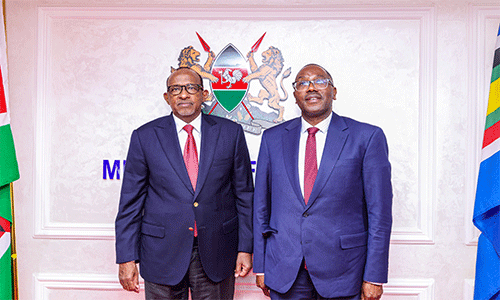
Achieving Kenya’s Universal Health Coverage (UHC) goals depends on strong strategic partnerships, effective resource utilization and a continued commitment to delivering results.
Cabinet Secretary for Health Hon. Aden Duale held discussions with a World Bank delegation, led by Ronald Mutasa, aimed at reinforcing the implementation of two major health initiatives: the Building Resilient and Responsive Health Systems (BREHS) Project and the Kenya Health Emergency Preparedness, Response and Resilience (KHEPRR) Project. Both projects are instrumental in supporting the ongoing transformation and strengthening of Kenya’s health sector.
The discussions centred on fast-tracking project implementation, addressing operational challenges and ensuring that available resources deliver meaningful improvements in healthcare services. Against the backdrop of emerging regional public health threats, which reinforce the importance of preparedness and resilience, the meeting highlighted the need for efficient resource utilization and prioritising investments in interventions that will have the greatest impact on the health and well-being of Kenyans.
Hon. Duale reaffirmed the Government’s dedication to ensuring that ongoing reforms in the health sector deliver tangible and measurable results, building on the achievements of the Social Health Authority (SHA), which has registered over 33 million Kenyans. He further stressed that investments in healthcare should contribute to the country’s broader economic transformation through the Bottom-Up Economic Transformation Agenda (BETA), with a focus on creating employment opportunities, promoting local manufacturing, strengthening workforce capacity and advancing digital innovation.
A major focus was ensuring that support from development partners is aligned with the Government’s health sector priorities through the One Plan, One Budget, One Monitoring and Evaluation Framework. This coordinated strategy aims to enhance implementation efficiency, strengthen health financing and fast-track digital health solutions, alongside other key interventions under the two projects.
The meeting further discussed strategies to strengthen the capacity and long-term sustainability of healthcare facilities through the Facility Improvement Financing (FIF) framework. Hon. Duale underscored the need to safeguard public resources through transparent financial practices, responsible spending and robust accountability mechanisms, while harnessing partnerships under Sustainable Development Goal 17 to broaden access to quality healthcare services.
The meeting emphasised the need for enhanced collaboration between national and county governments, transparent management of fund disbursements, regular procurement reporting and prompt resolution of implementation challenges. These steps are crucial in ensuring the effective utilisation of project resources and achieving tangible improvements in access to and the quality of healthcare services.
Participants at the meeting included Principal Secretary for Medical Services Dr. Ouma Oluga, Principal Secretary for Public Health and Professional Standards Ms. Mary Muthoni, Director-General for Health Dr. Patrick Amoth, Social Health Authority Chief Executive Officer Dr. Mercy Mwangangi, as well as representatives of the National Treasury, county governments and implementing partners.